
To master the arts.
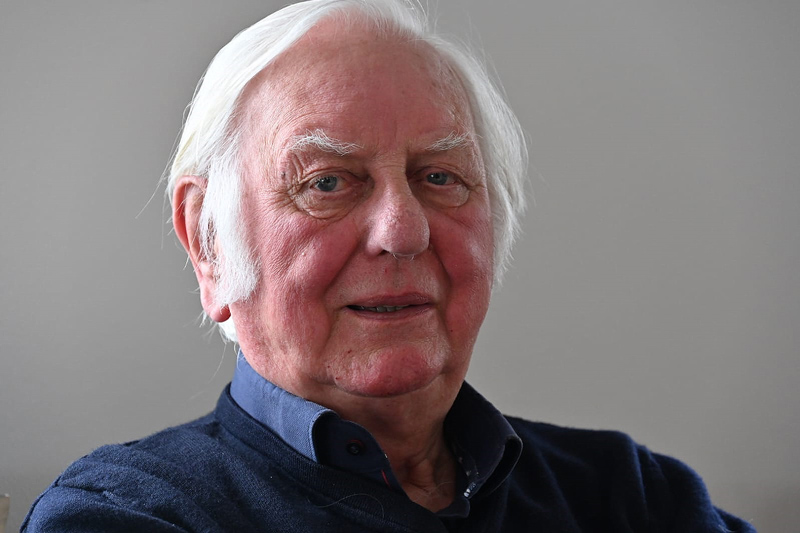
For Hans Joachim Köhlerʹs birthday
Even today, the now 90-year-old can still vividly recall the scene when, on Christmas Eve 1944, he and his father made a pilgrimage to the now world-famous little church in Seiffen, and the space expanded into infinity through the music played, and how the many people with lights streamed towards the church, while the two guests returned to their refuge, which the small family had found in the Ore Mountains after fleeing bombed-out Leipzig.
Looking back on a long life, it may seem inevitable to search for oneʹs roots, smooth over ruptures, and gloss over unpleasant details. Even Hans Joachim Köhler, the Leipzig music educator and Robert Schumann specialist who celebrated his ninth decade on February 18th, is not immune to this. And yet, his retrospective is remarkably clear and honest, as even his current life still holds surprises that challenge the narrative anew. For example, the poems and short stories by his mother, Charlotte, which only truly came to light a few years ago, as did his uncleʹs drawings — small character studies, perfectly captured with a practiced eye, and executed with impressive precision. They provide further sources for a life in which the arts played, and continues to play, a central role, if one wishes to avoid the somewhat pathos-laden phrase: that it was dedicated to arts. That wouldnʹt be applicable anyway, as his initial goal of becoming a performing pianist remained unattainable. Therefore, in 1954, Hans Joachim Köhler began studying music education and English studies at Martin-Luther-University in Halle/Saale and subsequently taught at a secondary school in Eilenburg. A lecture given on piano improvisation in the classroom brought him back to an academic career, encouraged by Hella Brock, who in 1960 had been appointed lecturer in music education methodology at the Ernst-Moritz-Arndt-University of Greifswald. Thus, he initially went to the Hanseatic-city as an assistant, which wasn’t that easy, as he now had a young family in Leipzig, and their second child was on the way. Itʹs no wonder that Köhler returned to Leipzig in 1963, where he became an assistant to Richard Petzoldt, Professor of Music History and Deputy Director of the Institute of Musicology at the University of Leipzig, and earned his PhD in 1966 with a dissertation on Béla Bartókʹs pedagogical piano-work “Mikrokosmosˮ as a path to listening to new music. From then on, he stuck to his last, working primarily in the field of artistic practice and training of music-teachers – from 1979 as a lecturer, and from 1992 until his retirement in 1999 as a professor of musical education. His major achievement, the publication of the 30-volume Urtext edition of Robert Schumannʹs piano works by C. F. Peters in Leipzig – initiated by Peter Hauschild – can also be seen within this continuity, since Schumannʹs “Album for the Youngˮ aims at the development of musical skills – playing and listening – much like Bartókʹs “Mikrokosmosˮ and Köhlerʹs work as a music-educator. For this significant project, which lasted until 1989, he received the Robert-Schumann-Prize of the city of Zwickau in 1978.
His involvement in the “Schumann Society Leipzig e.V.ˮ and in making the Schumann-House on Leipzigʹs Inselstraße accessible to the public was almost inevitable. The honoreeʹs growing interest was directed toward this and other authentic sites associated with Schumannʹs work, revealing a new artistic facet: photography. He seemed particularly drawn to the tension between the documentary nature of this medium today and its connection to earlier artistic milieus. While it is the authentic that initially attracts us — in Robert Schumannʹs case, the house on Inselstraße, the church where he and Clara were married in Leipzig-Schönefeld, and the Schumann-corner in the “Kaffeebaumˮ-café — traces of the past become apparent to the discerning observer when biographical contexts are brought to light. These traces are hidden in locations, perspectives, and connections to historical figures, buildings, and landscapes. In this way, the past becomes tangible in the present. Layers of time are revealed and connect with the individuality of the observer – the place acquires an aura, and those of today discover far more that is verifiable, opening themselves to its attraction.
The self-affirmation at the end of a rich life is directed toward oneʹs origins, and in retrospect there resonates the satisfaction that oneʹs diverse artistic talents have found a fitting expression in oneʹs own work, an expression that transcends oneʹs own lifetime. Thus, art becomes an elixir – not merely a glue for reconstructing an individual life, but a universal expression of human existence.
Leipziger Zeitung, February 19, 2026
Photo: Claudia Schwabe
Comments
To master the arts.<br> For Hans Joachim Köhlerʹs birthday — No Comments
HTML tags allowed in your comment: <a href="" title=""> <abbr title=""> <acronym title=""> <b> <blockquote cite=""> <cite> <code> <del datetime=""> <em> <i> <q cite=""> <s> <strike> <strong>